Stainless Steel Screw Jacks
About Stainless Steel Screw Jacks
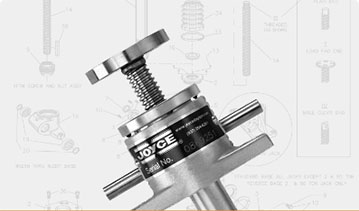
Joyce stainless steel screw jacks are specifically designed for positioning and lifting applications located in wet, corrosive, and harsh environments. Metallurgical properties of stainless steel allow it to remain ductile even at very low temperatures. These mechanical jacks are available in 2 ton through 25 ton capacities. Upright or inverted jacks operate at full capacity in tension or compression. Single lead jacks (SWJ) are self-locking; double lead jacks (DSWJ) require a brake motor or external locking device to hold position.
Why Choose Stainless Over Standard Machine Screw Jacks?
Stainless steel and bronze construction resists corrosion from moisture, wash-down chemicals, and salt exposure. Nitrile rubber seals protect internal mechanisms in wet or contaminated environments. Common applications include food and beverage processing, pharmaceutical manufacturing, marine equipment, and wastewater treatment.
Features
- All exposed surfaces and components feature stainless steel or bronze construction
- Nitrile rubber seals protect all internal mechanisms
- Tapered or ball thrust bearings provide rugged reliability
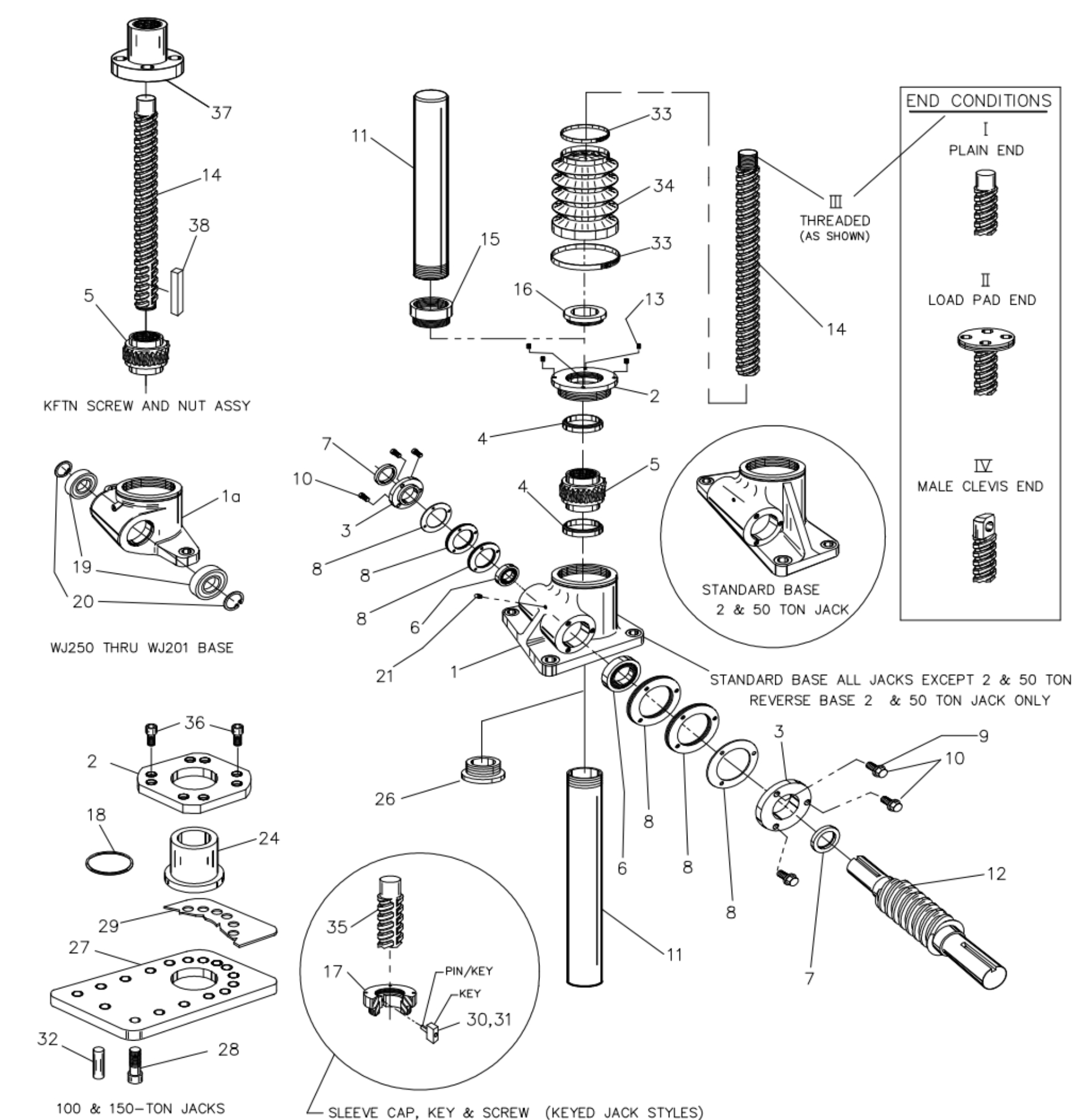
- Choose one of four standard end conditions
- Protective boots available
- Anti-backlash devices available
- Joyce/Dayton can customize to your specifications
- Custom finishes available
Parts list and exploded views are included in the O&M Manual. Serial numbers are attached to the product housing.
What You Need to Know to Specify Stainless Steel Screw Jacks
Stainless steel screw jacks are rated by static thrust capacity from 2 to 25 tons. Selecting the right jack also depends on:
- Column load. How high does the load need to rise? Choose a lifting screw stout enough to handle the load at full extension.
- Travel speed. Single lead jacks (SWJ) are best for slower, self-locking applications. Double lead jacks (DSWJ) move faster but require a brake motor or external lock, since they're not self-locking.
- Duty cycle. Like all machine screw jacks, heat builds up between the screw and nut during operation, so duty cycles need rest periods to dissipate it.
Jack Design Options
- Translating design jacks are most common. Rotation of the lifting screw is prevented, either by the load itself or by tying two or more jacks together.
- Keyed design jacks are used when rotation of the lifting screw is not restrained by the load, such as when the jack must lift to meet a load. A key fixed to the jack housing forces the lifting screw to translate without rotating.
- KFTN (Keyed for Traveling Nut) design jacks have a fixed, rotating lifting screw with a traveling nut attached to the load, ideal when a protection tube won't fit or a flush mount is required.
Every system powered by an electric motor requires a control system. Joyce/Dayton provides motor controls ranging from simple Motor Starters to complex positioning systems and Custom controls. At Joyce, we know that choosing the best option can sometimes be a challenge. That's why our Engineers are available to help you through the process. Contact us to learn more.
Technical Resources